
Electric Era
A modern brand to solve a modern problem
Their brand had been focusing on the complex technology they’d built, but they wanted to tell a more straightforward story–something that felt clean and elegant, but still tech‑forward. So we worked with the founders and leadership team to create new messaging, which we used as a platform for a new brand, new logo, and a new website.


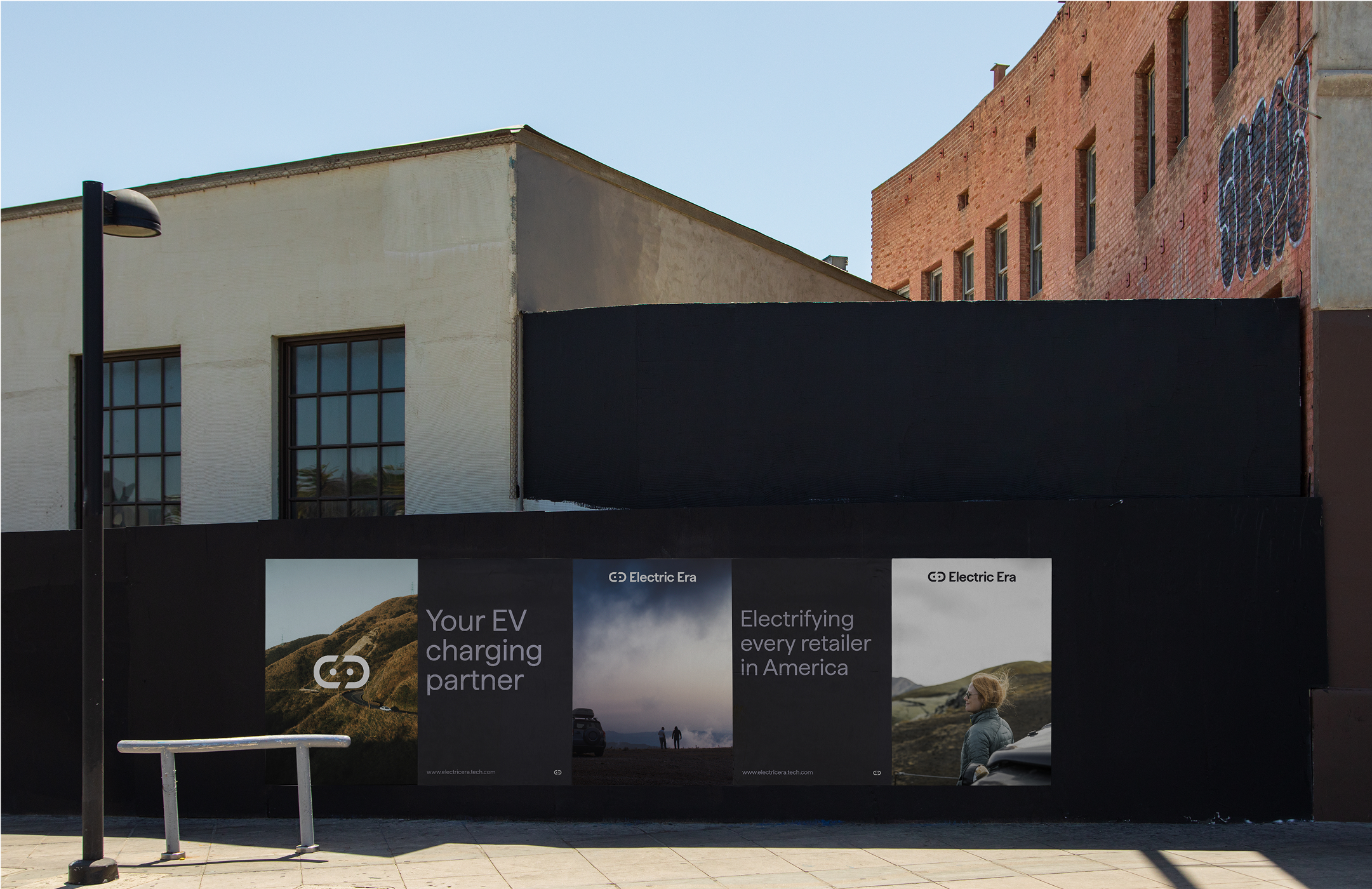


We also created a library of beautiful static and animated illustrations to support the storytelling. We led the web development of the new website and provided the UI/UX styling building blocks for their logged‑in business customer dashboard.

Squero is the perfect complement for technical founders. They perfectly captured the essence of what Electric Era is in just a few brief conversations and created a compelling future vision for the next step in our brand evolution.
Quincy, CEO & Co‑founder of Electric Era

Our approach
The American road trip, now electrified
We took the familiar vernacular of the great American road trip and gave it an electric flavor.
Use restraint… to stand out
We took a black and white, modernist approach to type and color, and removed excessive frills, to convey a professional, premium experience.
Clarity over gloss and gloss‑overs
There’s no such thing as over-explaining. We elevated diagrams to illustrations to demystify the tech.


FAQs
Do I need a creative agency and a production company, or can one team do both?
The traditional model separates the two: a creative agency develops the concept and script, then hands off to a production company to shoot and edit. That model adds cost, coordination overhead, and a point of friction where creative intent can get lost in translation.
For Fay's campaign, Squero handled the entire process — concepting, scripting, casting, art direction on shoot day, and post-production — as one team. The advantage is that the people who had the original creative idea are the same people making decisions on set and in the edit suite. For a brand running its first TV ad campaign, that continuity matters more than it does for a brand that has run dozens.
How many versions of a TV ad do I need to run a proper test?
Enough to test meaningfully different hypotheses, not just minor variations. For Fay's first streaming TV advertising campaign, Squero delivered eight unique edits from a single shoot — three distinct spot versions (each with a :30 and :15 cutdown), covering multiple messages, audience segments, and creative approaches.
That breadth lets Fay run real experiments across YouTube, OTT, and linear TV simultaneously rather than committing all their media spend to a single bet. The rule of thumb: if two versions are testing the same message with different visuals, that's iteration. If they're testing different emotional hooks or value propositions, that's a genuine test. A creative testing library should have enough of the latter to actually learn from.
Should I use real customers or actors in a health and wellness TV ad?
For health and wellness advertising, real customers almost always outperform actors on trust — particularly for a product where the mechanism is personal (a nutritionist who works with you one-on-one) and the category is crowded with claims that don't hold up. The challenge is that real customers are harder to cast, harder to direct, and less predictable on camera.
Turbo Testimonial solved this by removing the pressure from any single person: each real Fay customer says one line and hands off to the next. No one has to carry a full narrative. The result is authenticity at scale — eight real voices covering eight different reasons someone might find Fay relevant to their life.
For Fay's campaign, Squero handled the entire process — concepting, scripting, casting, art direction on shoot day, and post-production — as one team. The advantage is that the people who had the original creative idea are the same people making decisions on set and in the edit suite. For a brand running its first TV ad campaign, that continuity matters more than it does for a brand that has run dozens.


